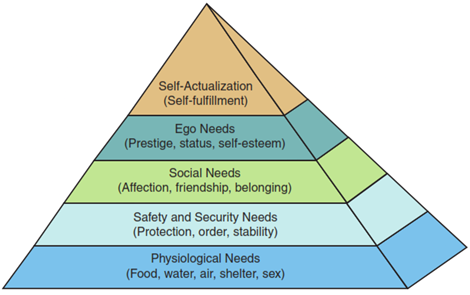
Psychologist Abraham Maslow formulated a theory of human motivation based on the idea that human needs are arranged in a hierarchy. Maslow's hierarchy of needs consists of five levels of human needs, ranked according to their importance, ranging from lower-level needs (biogenic) to higher-level needs (psychogenic). This theory states that individuals strive to satisfy lower-level needs before fulfilling higher-level needs. The lowest level of unsatisfied needs motivates a person's behavior. When those needs are sufficiently satisfied, individuals become motivated to fulfill the needs at the next level of the hierarchy. Once those needs are fulfilled, the needs at the subsequent level become the person's primary motivator, and so on.
PHYSIOLOGICAL NEEDS or physiological needs. According to Maslow, physiological needs are the first and most basic level of human needs. These primary needs are essential for maintaining biological life, including food, water, air, shelter, clothing, and sex, as well as all biogenic needs.
SAFETY NEEDS or security needs. Once physiological needs have been satisfied, safety and security needs become the driving force behind an individual's behavior. These needs are not only related to physical safety but also to order, stability, routine, familiarity, and control over one's life and environment. For example, health and access to healthcare are important security concerns. Savings accounts, insurance policies, education, and vocational training are all ways individuals fulfill their need for security.
SOCIAL NEEDS or social needs. The third level of Maslow's hierarchy consists of social needs, such as love, affection, belongingness, and acceptance.
EGOISTIC NEEDS or ego needs. When social needs have been more or less satisfied, the fourth level of Maslow's hierarchy becomes operative. This level includes egoistic needs, which are:
Inwardly directed ego needs reflect an individual's need for self-acceptance, self-esteem, success, independence, and personal satisfaction.
Outwardly directed ego needs include the need for prestige, reputation, status, and recognition from others.
SELF-ACTUALIZATION NEEDS or self-actualization needs. According to Maslow, once people have sufficiently satisfied their ego needs, they move on to the fifth level. Self-actualization needs refer to an individual's desire to fulfill their potential, that is, to become everything they are capable of becoming. For example, an artist may express themselves on a canvas, or a research scientist may strive to discover a new drug that can eliminate cancer.
References
Schiffman, L. G., & Wisenblit, J. L. (2015). Consumer Behavior, 11th Edition, Global Edition. England: Pearson Education Limited.
Olivia Barcelona Nasution, S.E., M.Sc